
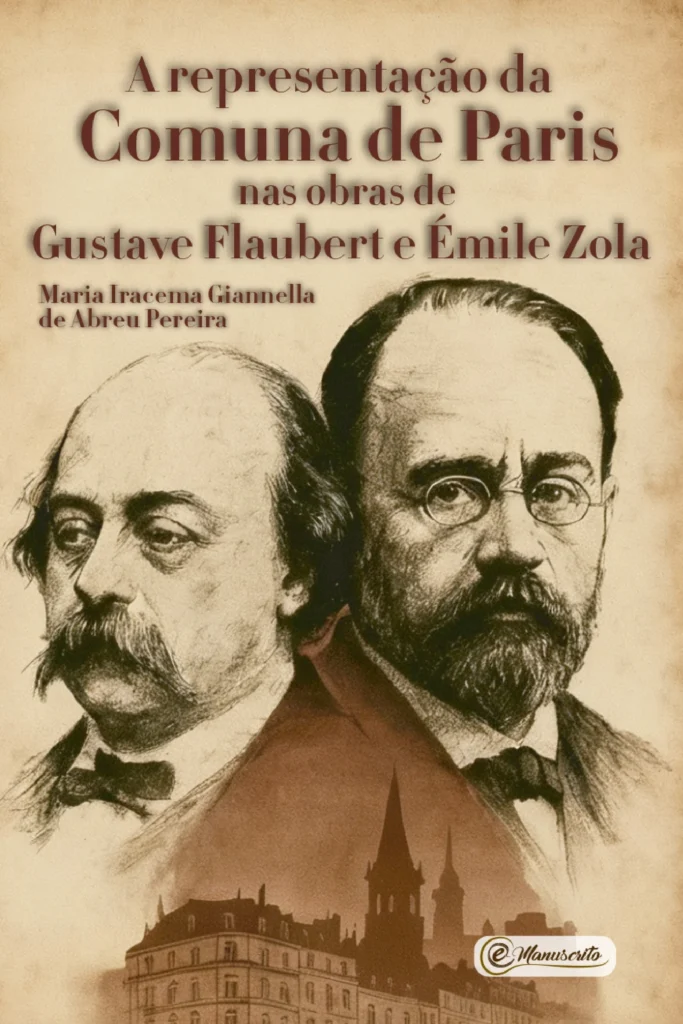
Flaubert, critic of the bourgeoisie, revealed himself as conservative; Zola, sympathetic to socialism, showed growing fear before the greatest popular revolution of the 19th century.
Gustave Flaubert, fierce critic of the bourgeoisie in his works, revealed himself as conservative and antidemocratic when facing the Paris Commune. Émile Zola, considered sympathetic to socialism, demonstrated growing terror as the violence of the communards intensified. These are some of the revelations in The representation of the Paris Commune in the works of Gustave Flaubert and Émile Zola, an e-Manuscrito release reaching the public in 2025.
The book, written by historian Maria Iracema Giannella de Abreu Pereira and prefaced by Leandro Karnal, delves into the letters, novels and articles of both writers to unveil how literature records — and betrays — the ideologies of its time.
72 days that changed history
The Paris Commune of 1871 lasted only 72 days, but remains one of the most fascinating episodes in modern history. Workers took power in the French capital and established a revolutionary government that abolished night work, separated Church and State, and created secular schools.
In times of growing social tensions, popular demonstrations and questions about representativeness, revisiting the Commune through literature also means reflecting on our present. The episode remains a fundamental reference for understanding the dynamics between popular revolt and political transformation.
Literary creation not only reflects, but also constitutes and questions the ideologies and worldviews of an era. Leandro Karnal, historian
Flaubert’s contradictions
Flaubert, author of L’Éducation Sentimentale (Sentimental Education) — a novel that unmasks bourgeois hypocrisy — revealed himself in his private correspondence, especially with George Sand, as a profoundly conservative man. His 107 letters written in 1871 (23 of them reproduced in full in the book) expose deep distrust of democracy and socialism.
Zola’s terror
Zola, in turn, covered the events as a journalist for newspapers La Cloche and Le Sémaphore de Marseille. The analysis of his articles and novels such as La Curée (The Kill) and L’Assommoir (The Dram Shop) reveals an adherence to the Commune far more nuanced and ambiguous than previously supposed.
Divided Paris
The work is not limited to literary analysis. By exploring the urban reform led by Baron Haussmann between 1853 and 1870, Maria Iracema shows how the transformation of Paris created a segregated city. Workers were expelled from the center to the periphery. The city became divided between rich and poor. These urban tensions — a central theme in Zola’s The Kill — culminated in the revolutionary explosion of 1871.
The contradictions of Flaubert and Zola remind us that the relationships between social classes, political power and culture are always crossed by ambiguities that don’t fit into simplistic categories.
Academic rigor
The research stands out for its rigor in selecting and analyzing material. Most of the letters and documents examined have no specialized translation into Portuguese, which makes the author’s mastery of French fundamental to the quality of the work.
Maria Iracema Giannella de Abreu Pereira, Master’s in History from PUC-SP and profound expert in French civilization, brings to the research not only academic rigor, but also the sensitivity of someone who intimately knows the language and culture she writes about.
Maria Iracema Giannella de Abreu Pereira has a solid Francophone background. She has always sought literature as an object of analysis. She chose two French giants: Zola and Flaubert. Leandro Karnal, historian
About the author
Maria Iracema Giannella de Abreu Pereira was born in 1967 in São Paulo. Bachelor’s and Master’s in History from PUC-SP, and Bachelor’s in Business Administration from Faap, she brings multidisciplinary training to her research. Married and mother of four children, she is a Francophone and profound admirer of French literature and civilization. The book is the result of her master’s thesis defended in the Graduate Program in History at PUC-SP.
Information
Title: The representation of the Paris Commune in the works of Gustave Flaubert and Émile Zola
Author: Maria Iracema Giannella de Abreu Pereira
Preface: Prof. Dr. Leandro Karnal
Publisher: e-Manuscrito
Year: 2025
Price: R$ 35
Buy: https://emanuscrito.com.br/Publicacao.aspx?id=628375
Photo: Press Release
Gostou do nosso conteúdo?
Seu apoio faz toda a diferença para continuarmos produzindo material de qualidade! Se você apreciou o post, deixe seu comentário, compartilhe com seus amigos. Sua ajuda é fundamental para que possamos seguir em frente! 😊