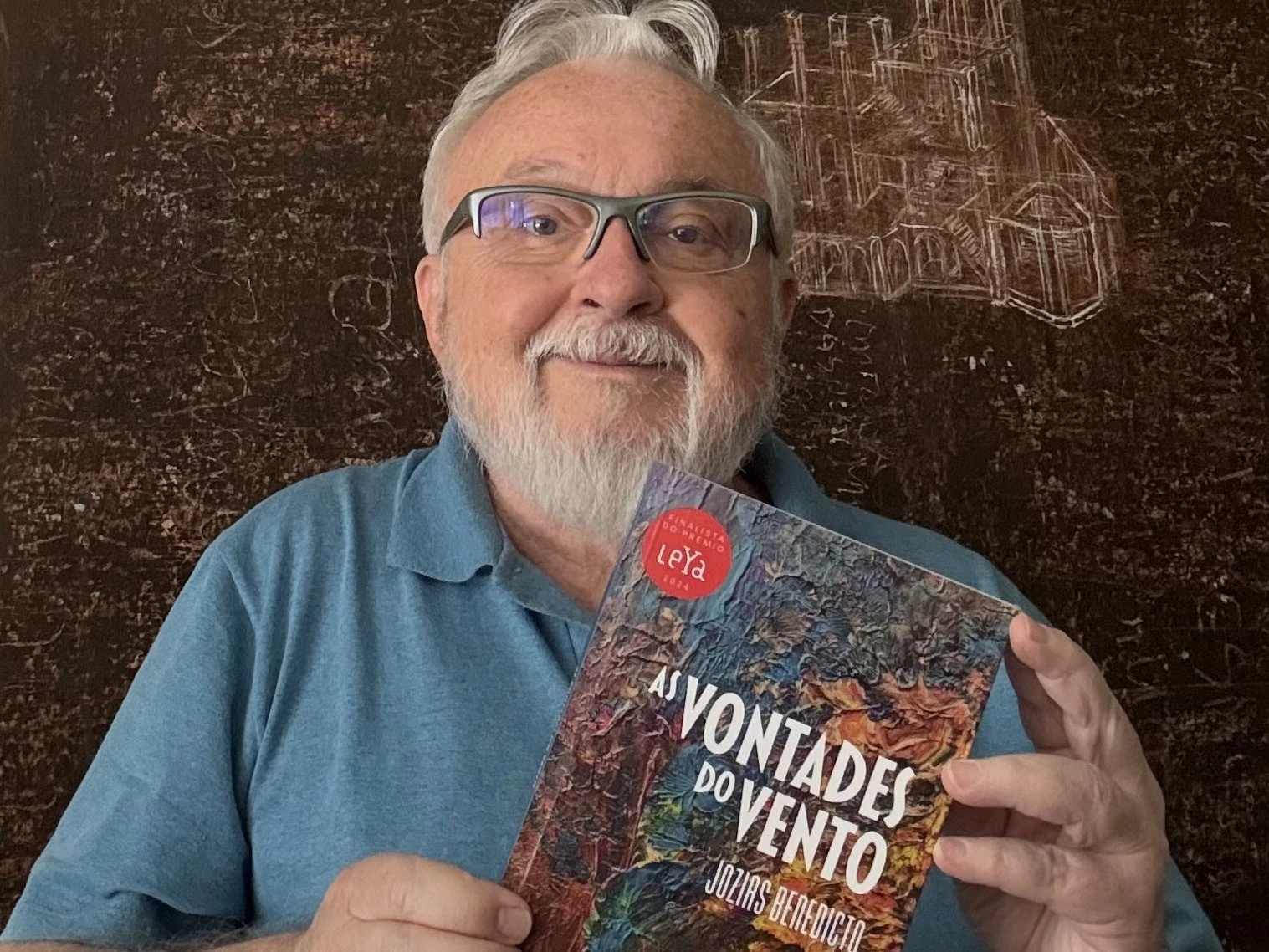
A 2024 LeYa Prize finalist, Jozias Benedicto channels grief and memory into “As vontades do vento”, a multi-voice magical-realist family saga.

At 74, Brazilian visual artist and writer Jozias Benedicto strengthens a literary path he only began publishing after turning 60. Released by Caravana Grupo Editorial, the 195-page novel uses family recollections and personal loss to explore time, kinship, and rebuilding through fiction rather than reportage.
A family story built on secrets
“As vontades do vento” blends life, death, and the passage of time through shifting narrators. The plot digs into a family marked by secrets involving the clergy, sex work, and a legacy tied to Brazil’s slaveholding past, while reflecting the friction between tradition and uneven modernization.
Benedicto says he deliberately avoided essays and straightforward social realism. “I never wanted to write an essay or nonfiction, nor a realistic, engaged novel—my path was the opposite: to develop these themes through fiction and its magical, fantastical strands,” he says.
49 chapters, many narrators
Structured in three parts—O Interior, A Travessia, and A Capital—the novel unfolds across 49 first-person chapters told by different characters. At its core are a door-to-door peddler father, a mother, and three sons—Joaquim, Pedro, and Bento—alongside figures such as Mocinha, the maid, and Elisa, a brothel madam.
Set in a small town in Brazil’s north in the 1950s, the story begins with the mother’s death and the children’s promise to fulfill her final wish. From there, the narrative loops back to trace the family’s rapid rise and the collapse that reshapes its heirs.
Magical realism enters as the dead also speak. Key to the unraveling are the maternal grandmother and her brother, a deceased Monsignor regarded as saintly in the town—voices that deepen the emotional stakes and propel the ending.
“With absolute command of language and narrative technique, the author carries the short story’s structure into a long-form narrative.”
The note comes from writer Andreia Fernandes on the book’s flap, highlighting how each chapter builds distinct voices, places, and sensory atmospheres—from an inland village to modern cities—without losing the larger narrative thread.
A late-blooming literary career
Born in São Luís, Maranhão, in 1950, Benedicto moved to Rio de Janeiro at 15 and lived there for most of his life. He spent 2006–2010 in Brasília and, since 2022, has divided his time between Brazil and Lisbon.
Trained in Information Technology, he worked in the field from 1970 to 2010. After 60, he committed fully to the arts, focusing on the intersection of literature and visual practice. He completed two postgraduate programs at PUC-Rio: Literature, Art and Contemporary Thought (2014–2015) and Body and Word in Performing and Visual Arts (2021–2022).
He also served as an editor at Apicuri (2010–2016), works as a curator, and writes critical texts for art exhibitions, in addition to publishing columns and reviews for the Luso-Brazilian outlet Estrategizando.
Award trail and LeYa recognition
Benedicto debuted in 2013 with “Estranhas criaturas noturnas” (Editora Apicuri) and has since published nine books spanning short stories, poetry, and novels. His distinctions include the Government of Minas Gerais Literature Prize, the Moacyr Scliar Prize, the Maranhão State Cultural Foundation Literature Prize, and the Pará State Literature Prize.
He has also been a finalist for the Sesc Literature Prize and now the LeYa Prize Portugal with “As vontades do vento,” underscoring a body of work shaped by mature experimentation.
Writing through loss
The author says writing helped him navigate personal losses, including his mother’s death and a fire in his apartment. Still, he draws a line between therapy and art: “Even if the book helped me overcome trauma, the therapeutic effect isn’t what moves me as an artist. What matters is whether the work reaches the reader,” he says.
Excerpt
“My father had a singular relationship—physical, almost sensual—with money. He liked counting bills and coins, cleaning them, arranging them by value, sensing their smell, weighing the bulk of folded stacks or piled coins (…).”
Service
Book: “As vontades do vento”
Author: Jozias Benedicto
Publisher: Caravana Grupo Editorial
Length: 195 pages
Purchase: https://caravanagrupoeditorial.com.br/produto/as-vontades-do-vento/
Photo: Divulgação