Italian-Brazilian artist Lucio Salvatore launches “Anni Venti,” a book and mid-length documentary drawing on two decades of unpublished notes, on April 13 in Rio.

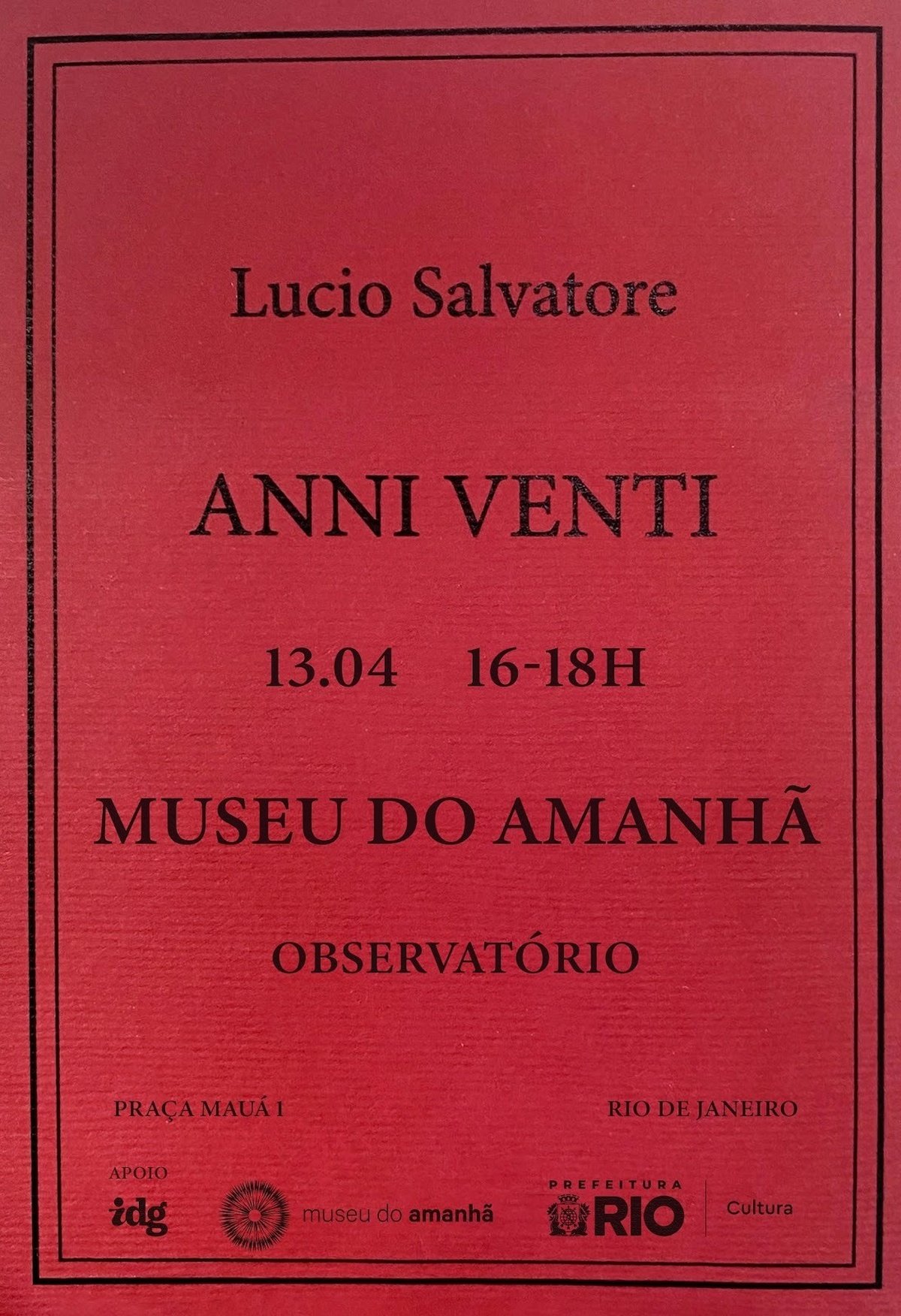
Italian-Brazilian artist Lucio Salvatore presents the book and mid-length documentary “Anni Venti” on Monday, April 13, at the Museu do Amanhã in Rio de Janeiro. The event, held at the museum’s Observatório space from 4 to 7 PM, is supported by the Italian Cultural Institute of Rio de Janeiro.
“Anni Venti” brings together personal annotations, notes, and reflections written by Salvatore himself over twenty years of artistic practice. These texts were never meant for publication — born close to his creative processes, they now reach audiences for the very first time.
Direct access to a mind at work
According to the Italian Cultural Institute of Rio de Janeiro, the raw and unmediated nature of these records is precisely what makes the project so compelling. This is not an external reconstruction of the artist’s career — it is direct access to his thinking as it searched for form.
For years, Lucio Salvatore‘s practice developed away from the logic of mediated visibility. His work traveled through exhibitions, residencies, and events without an explicit narrative or coordinated communication strategy. “Anni Venti” marks a decisive turning point, opening a more deliberate and wider conversation with the public.
In dialogue with the documentary of the same name — which assembles real-time footage fragments that survived the loss of archival material — the project is an invitation to take part in a living, ongoing research process.
Two decades of art between Brazil and Italy
Salvatore lives and works between Rio de Janeiro and Sant’Elia Fiumerapido, Italy. Over twenty years, his work has moved through museums, medieval churches, and public spaces, consistently charged with political and poetic urgency.
Among the highlighted projects in “Anni Venti” is “Defeito de Identidade” (Identity Defect), shown in 2025 in Brasília and São Paulo. The series of paintings investigates identity politics, migration, and displacement, confronting the forces that shape perceptions of belonging and exclusion.
“Fluxo Gênico” (Gene Flow, 2022), at the Museu do Meio Ambiente in Rio de Janeiro, emerged as an act of resistance against then-Minister Ricardo Salles’s attempt to convert the museum into a luxury hotel. The exhibition helped pave the way for the creation of the new Museu do Jardim Botânico.
“Campo” (Field, MNBA, 2021) was an activation project proposing to transform the Museu Nacional de Belas Artes in Rio de Janeiro into a field hospital for free SARS-CoV-2 testing for the local community.
In 2021, “Artemide” was shown in the 13th-century Church of Santa Maria Maggiore in Sant’Elia Fiumerapido. The exhibition offered a historical and spiritual experience — an opportunity to reflect on the survival instinct of ancestors identified with the precious 13th-century frescoes that have withstood time, abandonment, war, and looting. The title refers to the work “Artemide,” a mosaic made from pieces of cardboard packaging from the Artemide brand.
A landmark in Salvatore’s trajectory, “Metalementi” (2017–2018), curated by Fernando Cocchiarale at the Museu de Arte Moderna (MAM) Rio de Janeiro, was part of the institution’s 70th anniversary celebrations. The show serves as a bridge between early works like the “Combustões” and more conceptual ones such as “Post-ar,” “Autoesquemas,” and “Quadrado Preto.”
The “Parque Lage” exhibition occupied the Palazzo Pamphilj, home of the Brazilian Embassy in Rome, which simultaneously granted both the Portinari and Cortona galleries to Salvatore for a major selection of works shaped by his years at the Escola de Artes Visuais Parque Lage.
In 2016, at the solo show “Arte Capital” at the Centro Cultural Correios in Rio de Janeiro and at ArtRio, Salvatore introduced the celebrated series “Price Fields” — works made with price tags whose combined face value equals the total value declared on the labels.
In 2015, “Fragmento” at the Centro Cultural Correios presented the “Art Games” and iconic works including “Post_ar” — boxes of air shipped via the Brazilian postal service that were actually taxed by the Brazilian Federal Revenue Service.
At the MuBe – Brazilian Museum of Sculpture and Ecology in São Paulo (2011) and at the Centro Cultural Correios (2010), Salvatore presented “The Point of View of Life After Death”, a series of portraits made with each subject’s own blood, classified according to their self-declared identity.
Not an external reconstruction of the artist’s career, but direct access to his thinking as it searched for form.
Event Info
- Event: Launch of the book and documentary “Anni Venti” by Lucio Salvatore
- Date: Monday, April 13, 2026
- Venue: Museu do Amanhã — Observatório, Rio de Janeiro
- Schedule: 4:00 PM reception at the entrance | 4:30 PM welcome coffee | 5:00 PM opening remarks | 5:20 PM video screening | 6:00 PM Q&A | 6:20 PM closing coffee
- Institutional support: Italian Cultural Institute of Rio de Janeiro