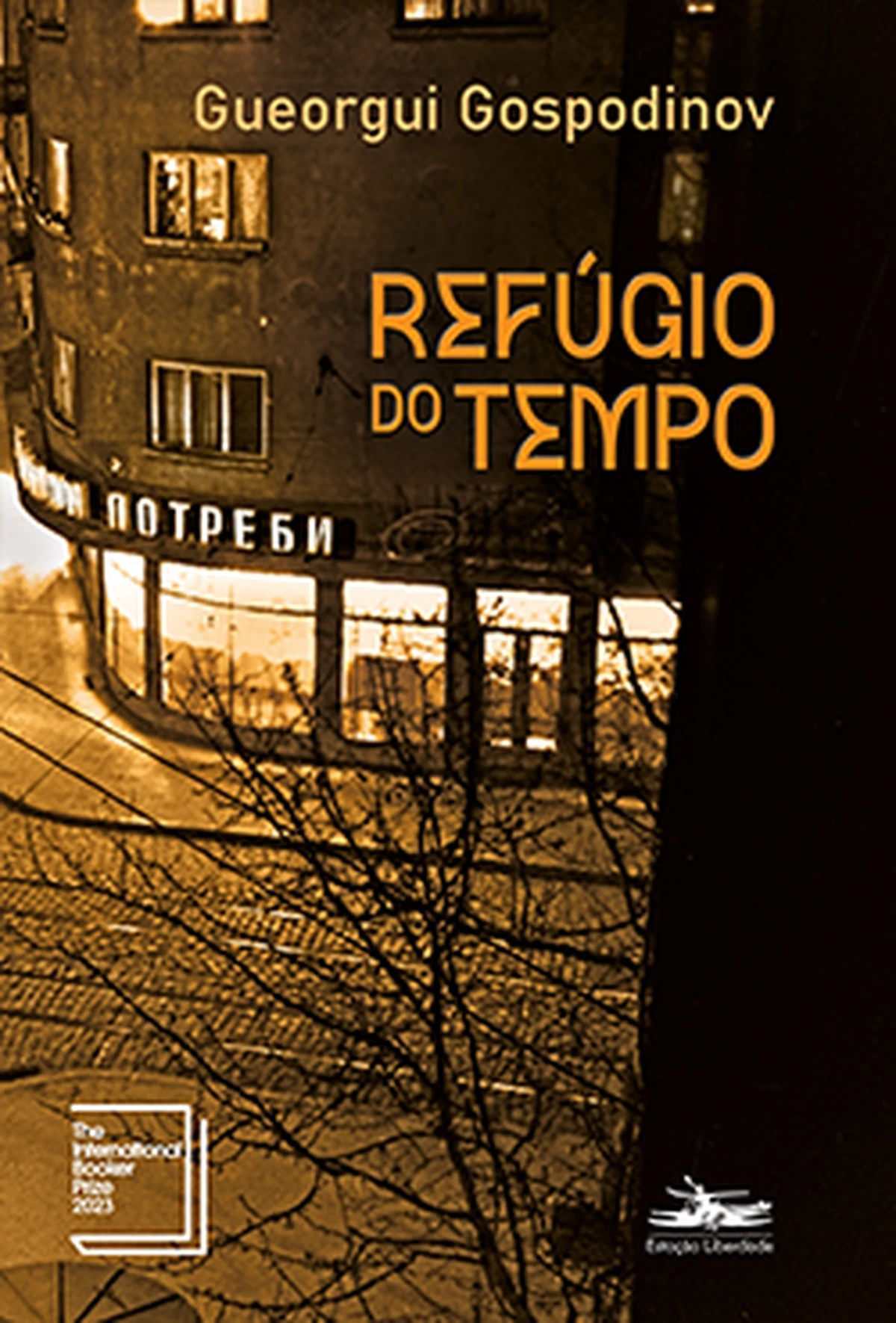
The 2023 International Booker Prize winner Time Shelter asks how far a society can escape the present before losing itself entirely.

The clinic of the past
At the heart of the novel is Gaustine, the author’s enigmatic alter ego and time traveler. He opens a “clinic of the past” to treat Alzheimer’s patients: each floor meticulously recreates a different decade, allowing patients to relocate themselves within their own memories. What begins as medical care quickly spirals beyond its creator’s control.
A Europe in crisis begins sending not just the ill, but healthy people — and even entire nations — in search of temporal refuge. Nostalgia, introduced as therapy, becomes a political epidemic. The past floods the present, with consequences that feel unsettlingly close to home.
“The past is not only what happened to you. Sometimes it is only what you yourself invented.” (p. 50)
Nostalgia as political critique
Gospodinov layers his narrative across distinct historical strata: the caricatured socialism of Eastern Europe, the chaotic transition to market economies, and the illusions that followed. With biting irony and lucid melancholy, he turns memory into an ideological battlefield. Remembering or forgetting stops being a private matter — it becomes a political act.
The novel anticipates — almost prophetically — the rise of movements that sell romanticized versions of the past as solutions to present-day crises. “And how much of the past can a person really bear?” the narrator asks on page 54. It is a question that resonates well beyond fiction.
Who is Georgi Gospodinov
Georgi Gospodinov, born in 1968 in Yambol, Bulgaria, is widely regarded as one of Europe’s most important living writers. A poet, novelist, essayist, and playwright, he studied Bulgarian Philology at Sofia University and completed his doctorate at the Institute of Literature of the Bulgarian Academy of Sciences.
His literary career includes Natural Novel (1999), a landmark of post-socialist Bulgarian prose, and The Physics of Sorrow (2012), written in response to a 2010 Economist article that called Bulgaria “the world’s saddest place.” His short story Blind Vaysha was adapted into an animated short nominated for an Academy Award in 2017. His most recent book, The Death of the Gardener (2024), explores grief through his own experience of losing his father.
Memory, forgetting, and healing
Gospodinov offers an uncomfortable inversion: remembering is not always the therapeutic path. In certain contexts, forgetting may be necessary for life to move forward. The novel provides no easy answers — only questions that linger long after the final page.
“I had a dream from which I managed to retain a single phrase: the innocent monster of the past. I forgot my dream, the phrase remained.” (p. 275)
The Brazilian edition is supported by the National Culture Fund of Bulgaria, reinforcing the commitment to bringing Eastern European literature to Portuguese-speaking audiences.
Event Info
- >Book: Time Shelter (Refúgio do tempo)
>Author: Georgi Gospodinov
>Award: International Booker Prize 2023
>Support: National Culture Fund of Bulgaria
Photo: Press release