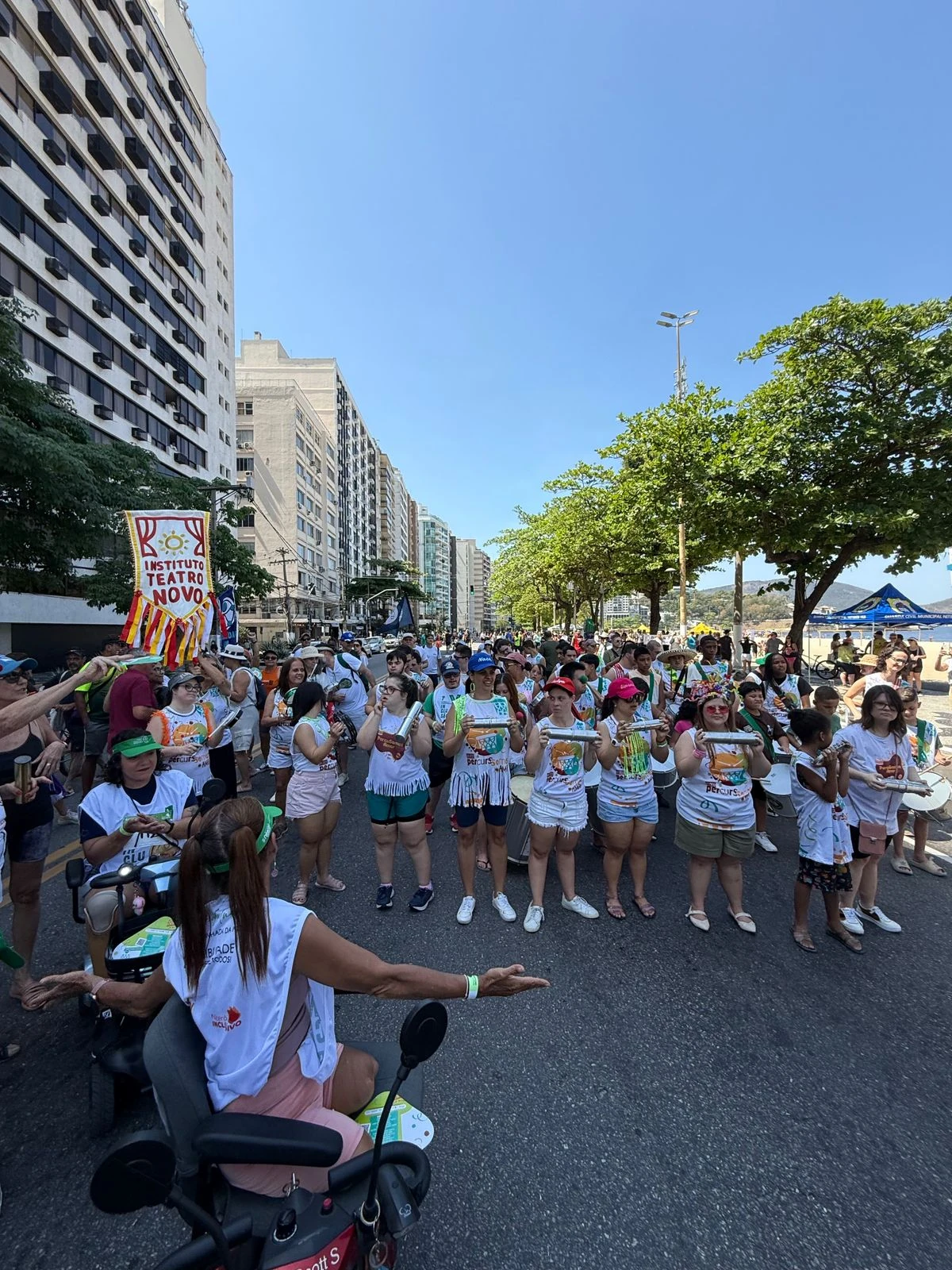
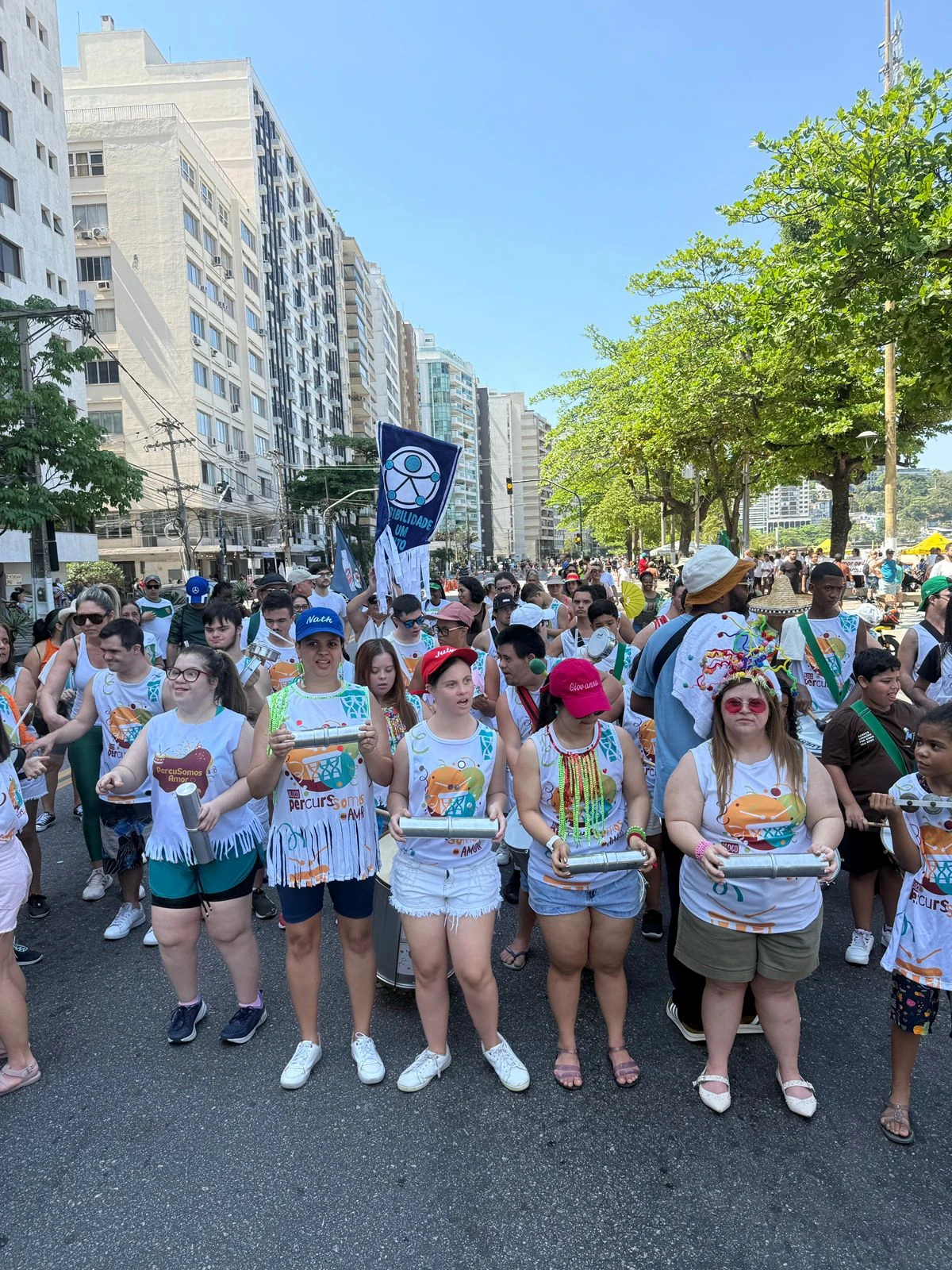
With 300 people with disabilities and the samba “Work is a right,” Percussomos do Amor parades on Feb. 22 in Niterói, Brazil.

“I didn’t choose the drum. It chose me”
That’s how Maria Fernanda, 21, describes her relationship with the surdo — a deep Brazilian percussion drum. She has Down syndrome, serves as a full member of Niterói’s Municipal Council for the Rights of Persons with Disabilities, and has been rehearsing every day ahead of the Percussomos do Amor block parade on February 22, 2026, at Praça Duque de Caxias, in the Gragoatá neighborhood of Niterói.
“I’m so happy. It’s going to be wonderful. I’m deeply moved,” says the percussionist. She plans to warm up by watching samba school parades — she roots for Mangueira and Viradouro — before taking to the streets with the block herself.
“I didn’t choose the drum. It chose me.” — Maria Fernanda, 21, percussionist and municipal councilwoman for the rights of persons with disabilities
A block born from inclusion
Percussomos do Amor grew out of the percussion workshop of the Práticas Acessíveis project, run by Instituto Teatro Novo, which develops artistic methodologies focused on people with disabilities. At its debut in 2025, the block drew more than 600 revelers. In 2026, organizers expect around 800 participants, at least 300 of whom have disabilities.
The rhythm section has about 70 percussionists, many of whom learned to play through the institute’s workshops. The block is officially part of Niterói’s carnival calendar, sponsored by the City of Niterói through Neltur – Niterói Empresa de Lazer e Turismo, with support from the Municipal Secretariat of Cultures.
A samba demanding work as a right
This year’s theme is “Work is a right.” The samba calls on society to recognize the real abilities of people with disabilities and open doors to fair career paths. A central focus is supported employment — a model that provides accessible tools and environments so these workers can thrive.
The samba will be led by Paulo Zerbinni, a wheelchair user. The message the block wants to leave on the streets is clear: “It’s not a favor — it’s a right.” A direct challenge to ableism and an affirmation of citizenship.
Full accessibility, from start to finish
The parade will feature a comprehensive accessibility structure: Brazilian Sign Language (Libras) interpreters, live audio description, augmentative and alternative communication (AAC) — including lollipop cards with symbols so block members can signal their needs during the parade — mobility support, and sound-dampening earmuffs.
For people on the autism spectrum (ASD), there will be a dedicated sensory regulation tent. Percussionists, artistic leads, and battery members are mostly people with disabilities — the protagonism here is not symbolic, it is structural.
Legal framework and national benchmark
The block is backed by Brazil’s Law of Inclusion, the UN Convention on the Rights of Persons with Disabilities, Municipal Law No. 3,821/2023, and Law No. 4,063/2025. Through this legal and cultural foundation, Percussomos do Amor positions Niterói as a national reference in anti-ableist cultural practices.
Event Info
Block: Percussomos do Amor
Date: February 22, 2026 (Sunday)
Gathering time: 8 a.m.
Parade start: 10 a.m.
Location: Praça Duque de Caxias – Gragoatá (next to the Fort) – Niterói, Rio de Janeiro, Brazil
Route: Praça Duque de Caxias – Fort – return to Praça Duque de Caxias
Duration: 4 hours (2h gathering + 2h parade)
Sponsors: City of Niterói | Neltur | Municipal Secretariat of Cultures
Photo: Press release / Divulgação