Brazilian Carnival has roots in ancient Roman and Greek festivals. Discover how a European celebration became the country’s biggest popular festivity.

Celebrated in the days leading up to Ash Wednesday, Carnival is directly linked to the Christian calendar and marks the period before the 40 days of Lent. The festival emerged as a rite of passage preceding Christian Lent, becoming a kind of “last breath” of flesh and worldly pleasures before spiritual retreat.
From Roman Saturnalia to the Christian calendar
The term’s origin possibly comes from the Latin carnem levare, or “to remove meat,” reinforcing the symbolic meaning of the farewell celebration before the period of fasting and penance. Despite its association with Christianity, the festival has even more ancient roots.
Before becoming part of the religious calendar, similar practices were already present in ancient celebrations, such as the Roman Saturnalia and rituals dedicated to Dionysus in Greece, marked by food, drink, and music.
While everything seemed “allowed,” the festival also reinforced limits: it always ended with the beginning of Lent, as if to say: now it’s time to withdraw Ana Paula Aguiar, History author at Sistema de Ensino pH
The historian explains how the Church chose to reorganize, rather than eliminate, these popular traditions, integrating them into the Christian calendar.
From Portuguese Entrudo to samba schools
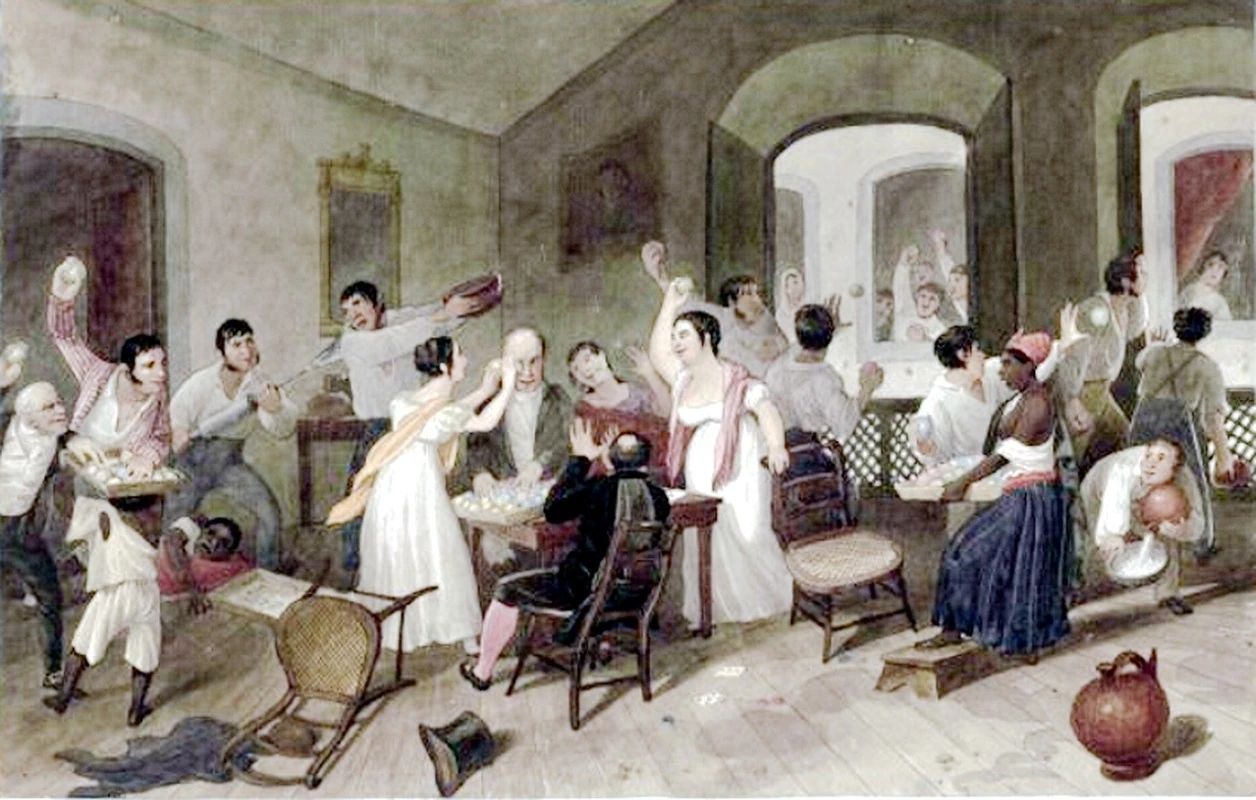
In Brazil, Carnival arrived during the colonial period, brought by the Portuguese through Entrudo, a popular practice that consisted of dirtying and wetting people in the streets. Although tolerated as a relief valve in a society marked by rigidity and inequality, Entrudo was also targeted by authorities, who considered it a “crude” celebration and attempted to ban it from the 19th century onward.
Over time, the celebration transformed and gained its own characteristics. The emergence of masked balls, street blocks, and later samba schools structured Carnival as an organized cultural manifestation. From the 20th century onward, samba took center stage, and the festival began engaging with social, historical, and political themes while maintaining its popular character.
Cultural heritage and Brazilian diversity
Today, the different ways of celebrating Carnival across the country reflect Brazilian cultural diversity. From Southeast parades to Northeastern sound trucks and manifestations like frevo and maracatu, the festival asserts itself as cultural heritage, preserving memories, popular knowledge, and forms of resistance that span generations.
More than a moment of revelry, Brazilian Carnival is a living expression of national history and identity that continues reinventing itself each year.
Photo: Wikimedia Commons