
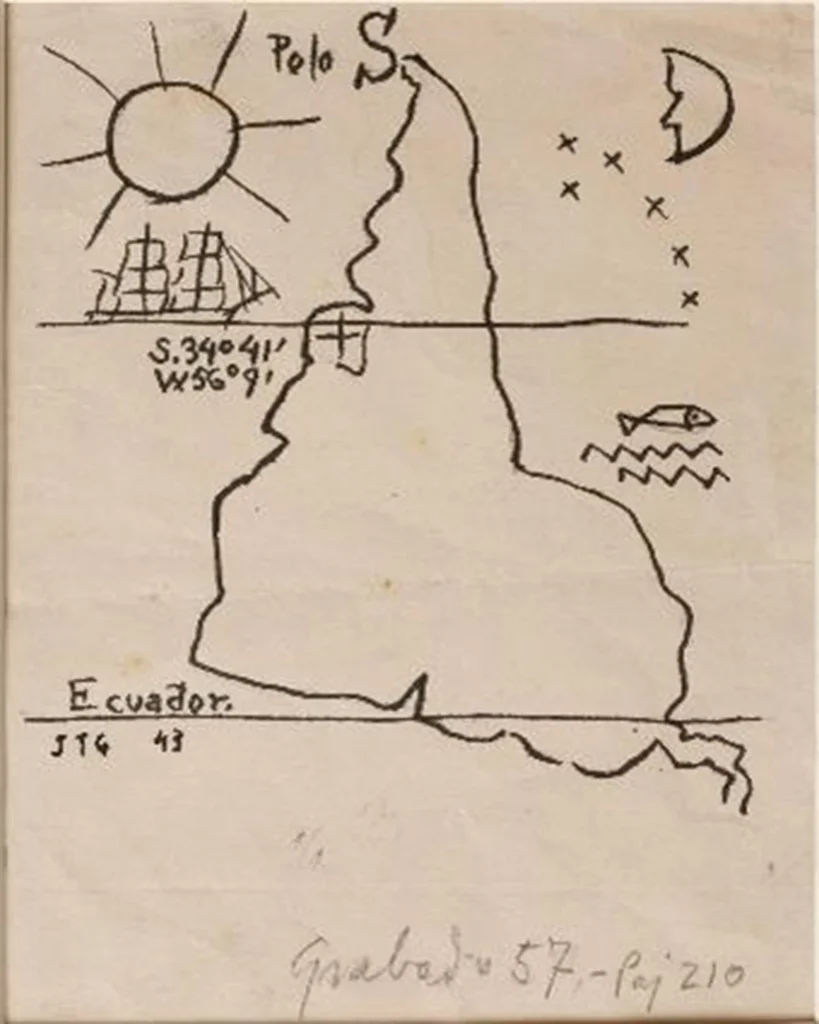
A flipped map becomes the message: “Joaquín Torres García – 150 years” opens at CCBB São Paulo with free entry and a call for cultural unity.
At a time of hardened borders and loud polarization, Joaquín Torres García – 150 years proposes something quieter—and deeper: changing the vantage point from which we read the world. Without turning geopolitics into a literal storyline, the exhibition argues for listening, belonging, and art as a bridge across the Americas.
With roughly 500 items on view—artworks, documents, manuscripts, publications, wooden toys, and teaching materials—the show introduces Brazilian audiences to one of Latin America’s defining modern artists. Its symbolic anchor is the iconic Inverted Map (1943), a lasting statement of the Global South’s cultural agency.
Torres García’s inversion is not a call for retaliation. It reads as an ethical and spiritual repositioning: seeing the South not as the periphery, but as a possible origin point for universal thought.
“It’s not enough to talk about decoloniality—you have to practice it. This show is a decolonial act because it restores the voice of an artist who thought from Latin America, without an inferiority complex.”
Developed in collaboration with the Museo Torres García, the curatorial narrative keeps returning to a central question: where does the heart of the Americas beat? Here, the answer isn’t a fixed point on a map, but the lived plurality of peoples, migrations, and cultures meeting in motion.
Constructive Universalism and listening
A cornerstone of the artist’s thinking, Constructive Universalism does not argue for a single, uniform world. Instead, it suggests that universal—often sacred—symbols, forms, and geometries appear across cultures. The “universal,” then, doesn’t erase difference; it emerges from recognizing it.
The exhibition builds itself as a space for reflection rather than a definitive verdict. It insists that culture grows through circulation, encounters, and displacement—and that integration of perspectives can be stronger than their opposition.
Brazilian echoes: 72 artists in dialogue
Torres García’s influence in Brazil crossed through Concrete and Neo-Concrete art and continued to ripple forward. In the show, that legacy takes shape via references to 72 Brazilian artists, presented as direct dialogues or as works shaped by his ideas.
Names cited and featured include Anna Bella Geiger, Alfredo Volpi, Hélio Oiticica, Cildo Meireles, Rubens Gerchman, Rosana Paulino, Jac Leirner, Rivane Neuenschwander, Leda Catunda, and Leonilson, among others who expand the exhibition’s continental lens.
Spatial concept and national tour
The exhibition design by Stella Tennenbaum works as both curatorial support and spatial metaphor. A continuous line runs through CCBB’s rooms, inspired by the Treaty of Tordesillas—less as a rigid border and more as a route to cross and rethink, emphasizing how South America’s cultural trajectories can diverge from colonial frames.
Selected through the CCBB 2023–2025 call, the exhibition starts its tour in São Paulo before heading to Brasília in March 2026 and Belo Horizonte in July 2026. In each city, it shifts subtly—reinforcing the idea that the South is not only a place, but a stance.
Visitor info
Exhibition: Joaquín Torres García – 150 years
Venue: CCBB São Paulo
Address: Rua Álvares Penteado, 112 – Centro
Dates: December 10, 2025 to March 9, 2026
Hours: 9 a.m. to 8 p.m., except Tuesdays
Free admission
Tour: CCBB São Paulo (December 10, 2025 to March 9, 2026)
Tour: CCBB Brasília (March 31 to June 21, 2026)
Tour: CCBB Belo Horizonte (July 15 to October 12, 2026)
Hours (CCBB SP): Open daily from 9 a.m. to 8 p.m., except Tuesdays
Contact: +55 (11) 4297-0600 | E-mail: ccbbsp@bb.com.br
Parking: Partner parking at Rua da Consolação, 228 (R$ 14 for a 6-hour period; ticket validation required at the CCBB box office). Free shuttle operates round trip from 12 p.m. to 9 p.m.
Van: Free round-trip van departing from Rua da Consolação, 228. On the return, it also stops at República subway station. From 12 p.m. to 9 p.m.
Public transit: CCBB is a 5-minute walk from São Bento subway station. Look for bus lines that stop on Ruas Líbero Badaró and Boa Vista.
Taxi/Rideshare: Drop off at Praça do Patriarca and walk via Rua da Quitanda to CCBB (200 m).
Accessible entrance (CCBB SP): Visitors with disabilities or reduced mobility can use the side door to the left of the main entrance, with ramp access.
Photo: ©Museo Torres García

Gostou do nosso conteúdo?
Seu apoio faz toda a diferença para continuarmos produzindo material de qualidade! Se você apreciou o post, deixe seu comentário, compartilhe com seus amigos. Sua ajuda é fundamental para que possamos seguir em frente! 😊