

São Paulo’s 2026 Municipal Theatre season blends classic opera with new works, plus orchestra concerts, choral series, chamber music and dance.
Guided by the question “what do we leave behind when the world as we know it collapses?”, the Theatro Municipal de São Paulo frames its 2026 program around the idea of legacy. After a 2025 season that consolidated changes and expanded artistic diversity, the new calendar deepens that path and invites audiences to reflect on the human condition and what we pass on to future generations.
The announcement brings together opera staples and bold modern pieces, the Municipal Symphony Orchestra series shaped by cultural influences on Brazil’s musical identity, the Coral Paulistano celebrating 90 years, the City String Quartet in dialogue-driven programs, and the São Paulo City Ballet with new creations and the return of a recent hit.
Opera: classics, modernism and commissions
The opera season opens with The Love for Three Oranges by Sergei Prokofiev, a revival of a 2022 success. Performances run on February 27 and 28, and March 1, 3, 4, 6 and 7, in a production conceived by Luiz Carlos Vasconcelos and staged by Ronaldo Zero, based on a libretto inspired by Carlo Gozzi’s L’Amore delle tre melarance.
The plot leans into fantastic surrealism while reworking Commedia dell’Arte traditions, following a king’s quest to cure his son’s melancholy. Musically, Prokofiev balances wit and invention between Russian idioms and late-romantic echoes.
Next comes Intolleranza by Luigi Nono, described by the composer as an azione scenica. It is scheduled for May 29, 30 and 31 and June 2, 3, 5 and 6, with conception and stage direction by Nuno Ramos and Eduardo Climachauska. The work follows a migrant worker arrested and taken to a concentration camp, using experimental techniques such as projections, text, film and electronic sound.
According to the program, Intolleranza will be staged for the first time in Latin America in 2026, bringing a landmark 20th-century avant-garde opera to the Theatro’s stage.
In July, Richard Wagner’s Tristan und Isolde arrives on July 22, 26, 29 and 31, and August 2. Based on the medieval legend narrated by Gottfried von Strassburg, the production marks director Daniela Thomas’s return to the Theatro, featuring tenor Simon O’Neill and soprano Annemarie Kremer in leading roles.
The story centers on a love potion accidentally consumed by Tristan and Isolde and the ensuing conflict when King Marke—Tristan’s uncle and Isolde’s husband—discovers the forbidden relationship. Wagner called it the most daring work of his life, pushing tonality and conventional harmony.
In September, Verdi’s Don Carlo returns after 20 years without a full staging in Brazil. Performances take place on September 18, 19, 20, 22, 23, 25 and 26, with Atalla Ayan in the title role, Luiz-Ottavio Faria as Philip II, and Ailyn Pérez appearing in her first complete opera production in Brazil. Staging and lighting are by Caetano Vilela.
Premiered in 1867, the opera unfolds through three main tensions: State versus Church, father versus son, and idealism versus authoritarian power, embodied by figures such as the Marquis of Posa and Philip II.
On October 30 and 31 and November 1, 3, 4, 6 and 7, a double bill pairs Brazil’s Jocy de Oliveira with Igor Stravinsky. The Theatro commissions a new opera from Jocy to mark her 90th birthday. A pioneer of electroacoustic music in Brazil, she has written 11 operas, including Fata Morgana, the first opera composed by a woman to be staged at Theatro Municipal de São Paulo.
Ana Vanessa will stage Jocy’s new work, while Georgette Fadel directs Stravinsky’s Oedipus Rex, with both artists making their Theatro debut as stage directors. Stravinsky’s opera-oratorio premiered in Paris in 1927 and belongs to his neoclassical period, created in partnership with Jean Cocteau.
The opera season closes with Umberto Giordano’s Andrea Chénier, on November 27, 28 and 29 and December 1, 2, 4 and 5. Based on the life of French poet André Chénier, executed during the French Revolution, the new staging is by Caio Araujo and Carla Camurati.
Municipal Symphony Orchestra: cultural roots
In the concert series, the Municipal Symphony Orchestra highlights how multiple cultures shaped Brazil’s musical identity. Programs include performances led by music director Roberto Minczuk and guest conductors such as Taiwanese-American Mei-Ann Chen, Zimbabwean-American Vimbayi Kaziboni and Chinese composer-conductor Tan Dun, alongside appearances by Coral Paulistano, the Theatro’s lyric chorus and guest soloists.
The season opens with Brazilian Forest on January 23, 24 and 25, conducted by Priscila Bomfim with pianist Hércules Gomes. The program includes Da Terra by Cibelle Donza, a work by Hekel Tavares, Alegres Trópicos: um baile na mata atlântica by Gilberto Mendes, and Villa-Lobos’s Choros No. 10, Rasga o Coração.
Symphonic Pictures follows on March 27 and 28 under Mei-Ann Chen, featuring Dança de Saibei by An-Lun Huang, Prokofiev’s Violin Concerto No. 1, Kaija Saariaho’s Nymphéa Reflection, and the suite from Stravinsky’s The Firebird.
On April 3 and 4, Roberto Minczuk conducts the Easter Concert, with special guests Reynaldo González Fernández (Afro-Cuban dancer) and Alfredo Tejada (cantaor). The program includes Osvaldo Golijov’s La Pasión según San Marcos, written in 2000 for the 250th anniversary of Bach’s death.
On April 24 and 25, conductor Ricardo Bologna and pianist Paulo Álvares lead Architectures of Sound, centered on 20th-century textures and structures. The program features Xenákis’s Psappha, Ligeti’s Piano Concerto, Lutosławski’s Concerto for Orchestra, and Marcos Balter’s Orum.
The 2026 season continues the orchestra’s Gustav Mahler focus. On May 1 and 2, the Municipal Symphony Orchestra, the Lyric Chorus and Coral Paulistano—conducted by Roberto Minczuk—perform When the World as You’ve Known It Doesn’t Exist by Ellen Reid, followed by Mahler’s Symphony No. 8, the “Symphony of a Thousand”.
On May 8 and 9, Vimbayi Kaziboni conducts Echoes of Berio, with Dreydl by Olga Neuwirth, He Stretches out the North… by Hannah Kendal, Your Network is Unstable by George Lewis (2024), and Luciano Berio’s Sinfonia for orchestra and eight amplified voices.
On July 24 and 25, under Maíra Ferreira, the orchestra and Coral Paulistano present Awakening, opening with Caroline Shaw’s In the swallow and continuing with Figura humana by Francis.
In another highlight, Tan Dun leads The World of Tan Dun, in a program devoted to his own music. He gained worldwide recognition, among other works, for the Academy Award–winning score to Crouching Tiger, Hidden Dragon (2001), blending Chinese musical traditions with Western orchestral language.
Coral Paulistano turns 90
The Coral Paulistano marks its 90th anniversary with a season spanning past, present and future. The opening concert takes place on February 12 under Maíra Ferreira, focused on Brazilian choral music and featuring the world premiere of Auto de Todo Mundo e Ninguém, a 1981 work by Camargo Guarnieri for choir, soloist, narrator and percussion, with text adapted by Carlos Drummond de Andrade from Gil Vicente.
One of the year’s highlights is Missa Afrossambas on June 12 and 13, conducted by Maíra Ferreira. The program pairs Carlos Alberto Pinto Fonseca’s Missa Afro-brasileira de Batuque e Acalanto with Baden Powell and Vinícius de Moraes’s Afrossambas, including songs such as Canto de Ossanha, Canto de Xangô and Canto de Iemanjá.
On July 2, Maíra Ferreira and Isabela Siscari lead an experimental program, featuring Pauline Oliveros’s Sound Patterns, Tania León’s El sendero ancho, Jaakko Mäntyjärvi’s Four Shakespeare Songs, two settings of the same Octavio Paz poem by Silvia Berg and Eric Whitacre, plus works by Gilberto Mendes and György Ligeti.
On September 24, Italian Renaissance brings together Giovanni Gabrieli, Raffaella Aleotti, Maddalena Casulana, Claudio Monteverdi and Luca Marenzio, under Maíra Ferreira and Isabela Siscari.
The season concludes on December 3, with Maíra Ferreira conducting and Renato Figueiredo and Rosana Civile on piano, in a program dedicated to the Nativity. The repertoire includes O Magnum Mysterium by Giovanni Gabrieli, Mendelssohn’s Sechs Sprüche, Op. 79, and Respighi’s Lauda per La Natività del Signore.
City String Quartet: musical dialogues
The City String Quartet builds its 2026 season around dialogue-based pairings across eras. The series opens on March 26 with Dialogues: Shaw, Mozart and Haydn, featuring Caroline Shaw’s Plan & Elevation (2015), Haydn’s String Quartet in B minor, Op. 33 No. 1, and Mozart’s String Quartet in D minor, K. 421 No. 15.
On April 30, the program pairs Pärt, Mozart and Haydn, with Arvo Pärt’s Summa (1978), Haydn’s String Quartet in E-flat major, Op. 33 No. 2, and Mozart’s String Quartet in E-flat major, K. 428 No. 16.
On May 28, Dialogues: Mozart, Haydn and Bingen opens with Hildegard von Bingen’s O Virtus Sapientiae in Marianne Pfau’s arrangement for string quartet, followed by Haydn’s String Quartet in C major, Op. 33 No. 3, and Mozart’s String Quartet in G major, K. 387 No. 14.
On June 20, Dialogues: Bologne, Mozart and Haydn features Joseph Bologne, Chevalier de Saint-George, with the String Quartet in G minor, Op. 1 No. 5, followed by Haydn (Op. 33 No. 4) and Mozart’s “Hunt” Quartet in B-flat major, K. 458 No. 17.
The series continues on August 20 with Haydn (Op. 33 No. 5) alongside Mozart’s String Quartet in G major “Spring”, K. 387 No. 14. On September 17, Dialogues: Montgomery, Mozart and Haydn includes Jessie Montgomery’s Strum, Haydn’s String Quartet in D major, Op. 33 No. 6, and Mozart’s String Quartet in A major, K. 464 No. 18.
On October 22, the quartet performs Emilie Mayer, Mendelssohn and Schumann, opening with the slow movement from Mayer’s String Quartet No. 2, followed by Mendelssohn’s String Quartet No. 1 and Schumann’s String Quartet No. 1. The season ends on November 26 with Florence Price (the Juba movement from her Second Quartet), Brahms (String Quartet No. 1 in C minor) and Dvořák’s “American” Quartet.
São Paulo City Ballet: new works and a return
The São Paulo City Ballet opens 2026 with a new creation by Renan Martins, on March 14, 15, 18, 19, 20 and 21. Titled Encruzilhada, the piece explores encounter, conflict and collectivity as practices of resistance, drawing on Brazilian popular dances and historically marginalized movement languages such as footwork, street and ballroom dance.
The second run takes place on June 20, 21, 24, 25, 26, 27 and 28 in the Theatro’s main hall, featuring a new creation by Andrea Peña and Michelle Moura. Peña revisits Latin American roots through a postcolonial lens, while Moura advances long-term research into psychophysical shifts and the body’s relationship to sound and language. The score will include Kaj Duncan David and Latin Grammy winner Rodrigo Lemos.
On August 15, 16, 18, 19, 21, 22 and 23, Requiem SP returns, created by artistic director Alejandro Ahmed after strong critical and audience reception in 2025. With the Municipal Symphony Orchestra and Coral Paulistano, the performance begins with György Ligeti’s Requiem and moves into a second act set to Venetian Snares’s intense electronic compositions, with 17 dancers and an immersive scenic integration of technology, light, objects and sound.
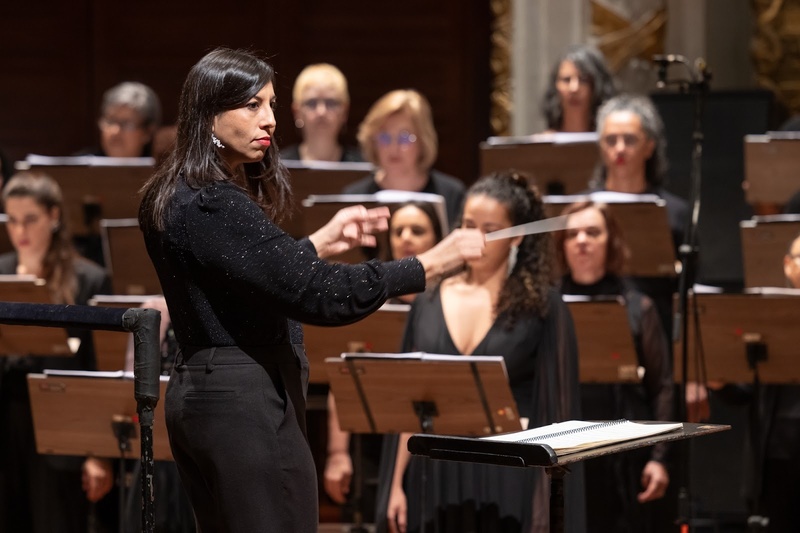
Photo: Rafael Salvador/Divulgação




Gostou do nosso conteúdo?
Seu apoio faz toda a diferença para continuarmos produzindo material de qualidade! Se você apreciou o post, deixe seu comentário, compartilhe com seus amigos. Sua ajuda é fundamental para que possamos seguir em frente! 😊