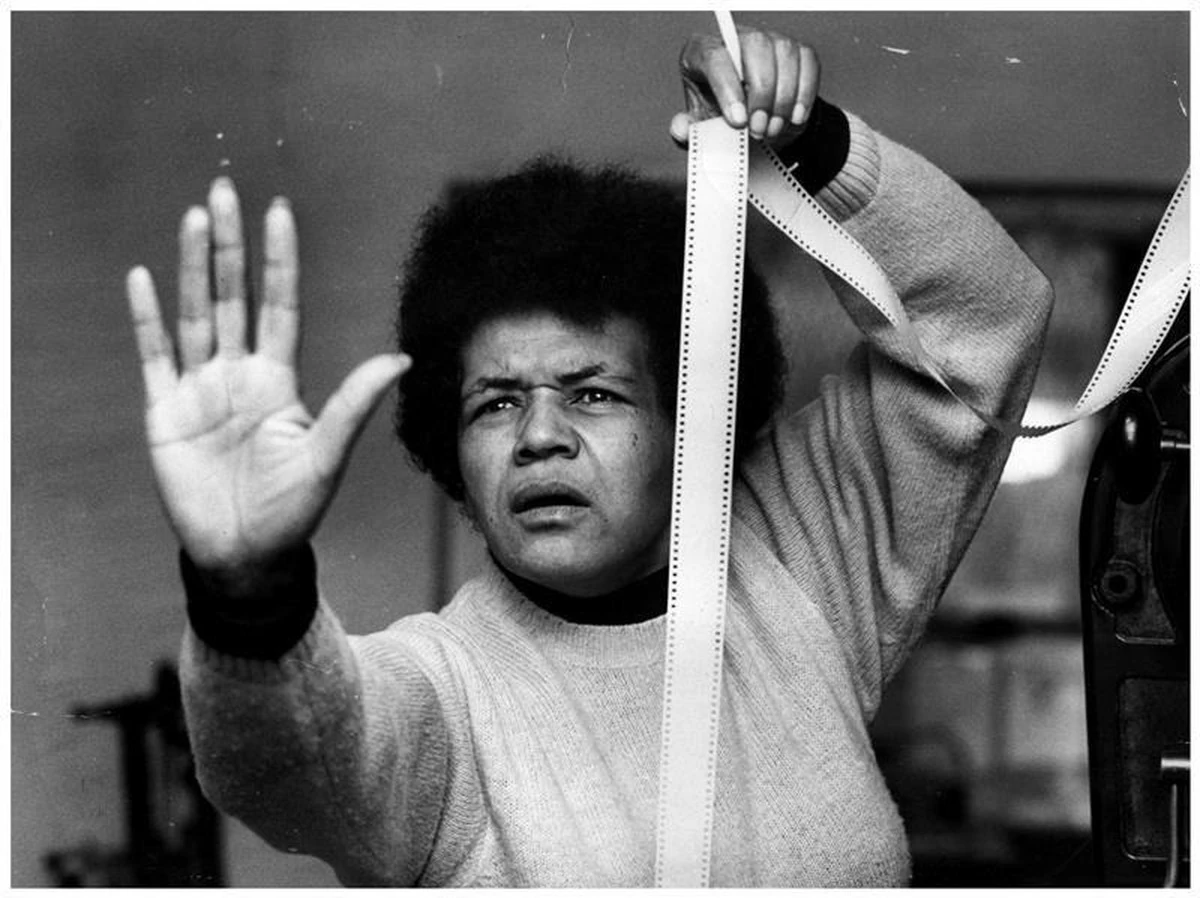
First comprehensive exhibition of the Franco-Guadeloupean filmmaker in Brazil showcases 34 works redefining Black and women’s cinema history. Free admission through March.

The Centro Cultural Banco do Brasil São Paulo opens its doors to “The Anti-colonial Cinema of Sarah Maldoror,” a retrospective marking a turning point in how we understand the history of Black and women’s cinema. With free admission and curated by Lúcia Monteiro, Izabel de Fátima Cruz Melo, and Letícia Santinon, the exhibition presents 34 works — 19 directed by the Franco-Guadeloupean filmmaker and 15 by partner filmmakers — from February 21 to March 22.
Who was Sarah Maldoror
Sarah Maldoror (1929-2020) was a central figure in global anti-colonial cinema. Born in France to a Guadeloupean father, she built a revolutionary filmography focused on African liberation movements. Her films document and dramatize revolutionary fronts in Angola, Guinea-Bissau, and Cape Verde, interweaving political rigor with poetic sensitivity and, fundamentally, female protagonism in African insurgencies.
Her legacy transcends historical documentation. Maldoror questioned how the West perceived Africa and anti-colonial struggles, shifting focus toward human subjectivity and voices frequently silenced in dominant narratives. Intellectuals like Aimé Césaire and Léopold Senghor shaped her creative trajectory.
A decade in the making
“We have been planning a retrospective of Sarah Maldoror’s work in São Paulo for ten years. Her films speak to the struggle against colonialism, racism, and prejudice,” notes curator Lúcia Monteiro. The retrospective reflects a broader repositioning of the filmmaker in cinema history, as highlighted by Izabel de Fátima Cruz Melo: “We believe initiatives like this contribute both to public knowledge and to the deeper reflection of critics and scholars.”
Opening with restored Sambizanga
The exhibition opens on Saturday, February 21, at 4:30 PM, with a commented screening of Sambizanga (1972), Maldoror’s most renowned work and Berlin Film Festival award-winner. Based on a novella by Luandino Vieira, the film follows a man unjustly imprisoned and tortured, suspected of belonging to a revolutionary movement. The version on display has been restored, and after the screening, Henda Ducados — economist, sociologist, and Maldoror’s youngest daughter — participates in a public discussion.
We have been planning a retrospective of Sarah Maldoror’s work in São Paulo for ten years. Her films speak to the struggle against colonialism, racism, and prejudice — Lúcia Monteiro, curator
Family presence and contemporary filmmakers
Annouchka de Andrade, Maldoror’s eldest daughter and founder of “The Friends of Sarah Maldoror and Mario de Andrade,” also participates. She leads a conference on Sambizanga on Saturday, February 26, and takes part in discussions about her mother’s unrealized screenplays throughout the exhibition.
The retrospective establishes dialogues between Maldoror’s work and contemporary Black female filmmakers. Safira Moreira, a Bahian filmmaker, directs a dramatic reading of the unrealized screenplay “The Little Girls and Death.” The exhibition also screens her debut feature, Cais (which premiered at the International Cinema Festival), and four of her short films.
Essential films from the retrospective
Beyond Sambizanga, the schedule includes screenings of Monangambééé (1968), a short depicting Portuguese colonial abuses in Angola; Aimé Césaire, a Man, a Land (1976), a documentary on the Negritude ideology founder; and A Dessert for Constance (1981), a feature following two immigrant workers in Paris seeking ways to return home.
The exhibition also highlights Maldoror’s work as an assistant: Gillo Pontecorvo’s classic The Battle of Algiers (1966) and Ahmed Lallem’s documentary Them (1966) — making its city premiere. Films by Chris Marker, such as Sans Soleil (1982), contain footage she filmed.
Courses and theoretical depth
The retrospective extends beyond screenings. It offers two courses: “Memory and Ancestry” with Lilian Santiago and Lúcia Monteiro, and “Restoring Video Archives from Television” with Nathanaël Arnould (who restored Maldoror’s television work at France’s National Audiovisual Institute), Eduardo Morettin (USP), and Daniela Siqueira (UFMS).
Information
Retrospective: The Anti-colonial Cinema of Sarah Maldoror
Location: Centro Cultural Banco do Brasil São Paulo, Rua Álvares Penteado, 112 – Historic Downtown – SP
Dates: February 21 to March 22, 2026
Free Admission: Tickets available from 9 AM on the day of each session, at the CCBB box office and on bb.com.br/cultura
Rating guidelines: Check each session’s rating on the CCBB SP website
Hours: Open daily from 9 AM to 8 PM, closed Tuesdays
Contact: (11) 4297-0600
Full schedule: bb.com.br/cultura
Transportation: CCBB is 5 minutes from São Bento Metro Station. Partnered parking available at Rua da Consolação, 228 (R$ 14 for 6 hours; validation required at the box office). Free shuttle service from 12 PM to 9 PM (with return stop at República Metro).
Photo: Disclosure