
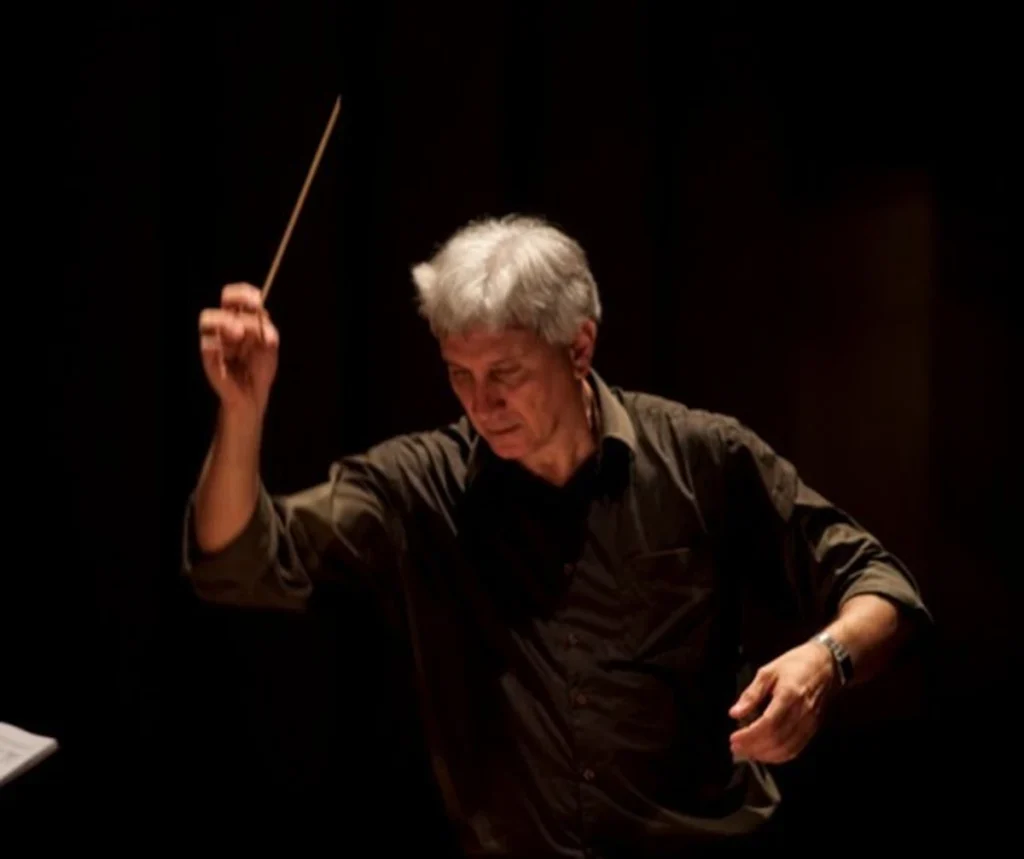
With 40 years of career, maestro Ricardo Rocha reveals at Villa-Lobos Music School why every conductor draws a unique sound from the same ensemble.
What separates a conductor from a mere time-beater? For Ricardo Rocha, founder and music director of the Cia. Bachiana Brasileira, the answer goes far beyond baton technique — it lives in empathy, leadership, and what he calls the “sanctuary of the spirit” within each musician. That understanding, built over 40 years of national and international work, is the heart of his course Conducting as Art, offered at the Villa-Lobos School of Music in Rio de Janeiro.
Seven Saturdays to unlock the mystery of conducting
The course runs across seven Saturday sessions, from 10 a.m. to 2:30 p.m., in March (14th, 21st, and 28th) and April (4th, 11th, 18th, and 25th) 2026. Classes take place at the Villa-Lobos School of Music, Rua Ramalho Ortigão, 9, in downtown Rio de Janeiro.
Both active conducting students and auditors are welcome, with no age restrictions — the course is designed for beginners, working professionals, and conducting teachers alike.
The philosophy behind the baton
“That is why each conductor draws a different sound from the same ensemble performing the same score: the group synergistically reflects the amalgam of each individual’s sound. This is the mystery of Conducting. It is not simply about how the conductor articulates the musical discourse, but about the fact that the ensemble’s timbre changes according to the conductor, acquiring a sonic personality that is the conductor’s own voice. It is a rigorously empathetic and spiritual process — one that cannot be learned from books or produced mechanically. Here lies the subtle distinction between the maestro, who orients and leads, and the conductor, who points the direction and induces it. These are distinct qualities that must walk together.” – Maestro Ricardo Rocha, founder and music director of Cia. Bachiana Brasileira
This perspective shapes the entire curriculum. Rather than focusing solely on score analysis or gestural patterns, the program also tackles the subliminal dimensions of musical leadership — the subtle difference between directing and inducing an ensemble.
What the curriculum covers
Sessions include conducting fundamentals and baton technique, structural score analysis, piano-accompanied conducting, theoretical topics on leadership, and rehearsals with active students. The didactic repertoire includes:
Binary orchestral conducting: Beethoven, Symphony No. 1 in C major, Op. 21 — First movement
Ternary choral-orchestral conducting: Bach, Chorale from Cantata BWV 147, “Jesu, Joy of Man’s Desiring”
Quaternary orchestral conducting: Villa-Lobos, Prelude from Bachianas Brasileiras No. 4; Sibelius, Symphonic Poem Finlandia, Op. 26
Quaternary choral-orchestral conducting: Mendelssohn, Oratorio Elijah, Chorus No. 29
Orchestral conducting in 6/8: Schubert, Symphony No. 5 in B-flat major, D 485 — Second movement
Most scores are available for free download at IMSLP. For Sibelius’s Finlandia — the only complete work on the program — the printed edition from Breitkopf & Härtel is recommended.
Certificate valid as university extension course
All participants with at least 75% attendance receive a certificate valid as a university extension course. The document specifies the participant’s category (active student or auditor), lists the works studied, and records the course hours, dates, and venue — signed by the maestro himself.
Practical Info
Course: Conducting as Art — Introduction to Choral-Orchestral Conducting in 7 sessions with Maestro Ricardo Rocha
Dates: Saturdays — March 14, 21 & 28; April 4, 11, 18 & 25, 2026
Time: 10 a.m. to 2:30 p.m.
Venue: Escola de Música Villa-Lobos — Rua Ramalho Ortigão, 9, Centro, Rio de Janeiro
Registration fee: R$ 100.00 | Auditors: R$ 300.00 (total) | Active students: R$ 600.00 (total)
Info & registration: (21) 3556-8404 or https://www.emvilla-lobos.com/regencia
Presented by: Escola de Música Villa-Lobos | FUNARJ | Secretaria de Cultura e Economia Criativa do Estado do Rio de Janeiro
Supported by: Leia Brasil — Non-Governmental Organization for Reading Promotion
Photo: Divulgação
Gostou do nosso conteúdo?
Seu apoio faz toda a diferença para continuarmos produzindo material de qualidade! Se você apreciou o post, deixe seu comentário, compartilhe com seus amigos. Sua ajuda é fundamental para que possamos seguir em frente! 😊