
The 29th Tiradentes Film Festival packed the Cine-Tenda and honored Karine Teles with the Baroque Trophy, amid calls for public policy for film.
The opening ceremony brought together government officials, public-sector leaders, filmmakers, business figures, and journalists. Beyond launching the film program, the night kicked off a week of conversations on culture, public policy, and the strategic role of Brazil’s audiovisual industry.
A hub for ideas and action
Raquel Hallak, the festival’s general coordinator, highlighted the event’s long-standing commitment to new voices and new creative paths in Brazilian cinema. “There is an imagination that rises from many Brazils and proposes many ways of existing. Since the beginning, the festival chose to bet on these new leading roles and possibilities,” she said.
Hallak argued for platform regulation, broader access to public policy tools, and strengthening Brazilian cinema as both an economic and symbolic force. Alongside institutional partners, she also officially launched the 2026 activities of the Cinema sem Fronteiras program, including the announced dates for CineOP and CineBH.
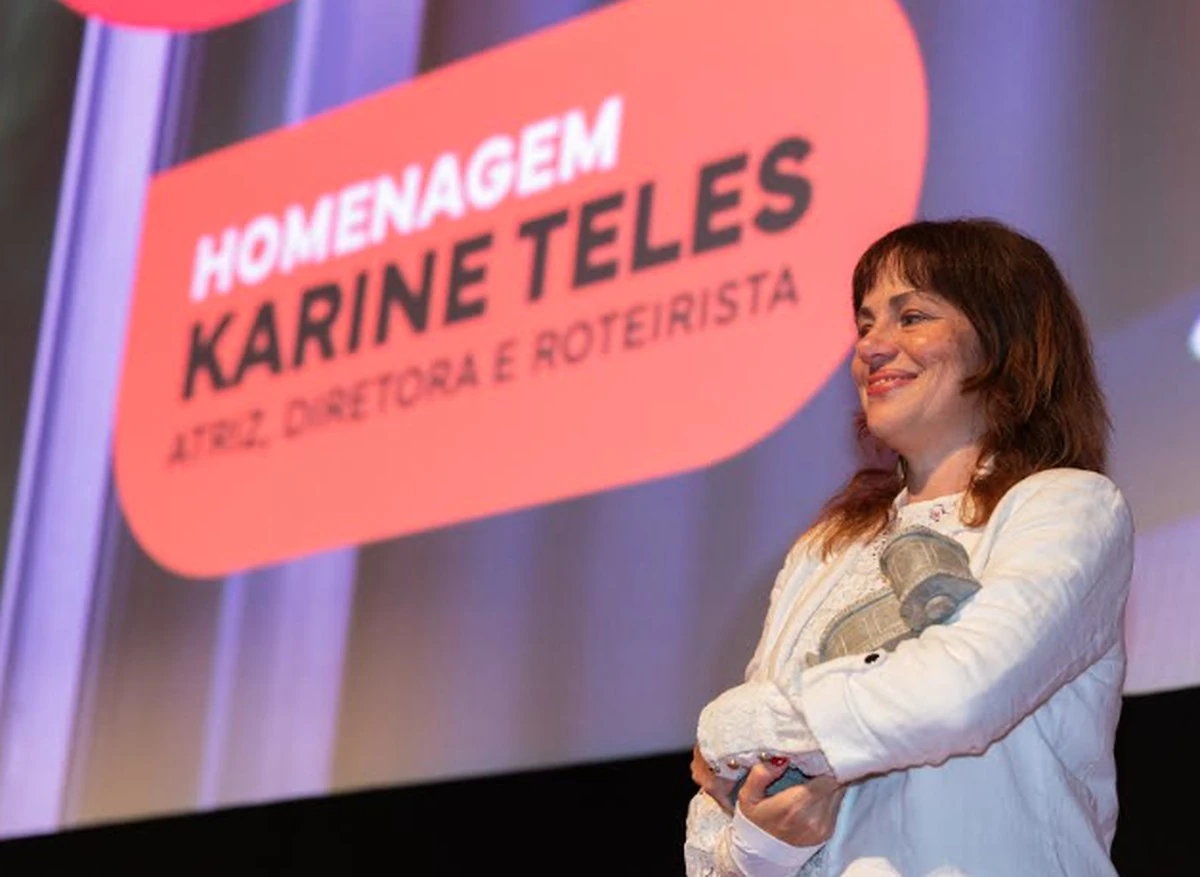
Karine Teles receives the Baroque Trophy
This year’s honoree, actor and director Karine Teles, received the Baroque Trophy recognizing a career spanning more than two decades. Visibly moved, she took the Cine-Tenda stage with her family, in a tribute that underscored her authorship-driven choices, artistic range, and commitment to filmmaking.
In her remarks, Teles spoke candidly about the instability of cultural work in Brazil. “Those who work with culture, education, and art in our country know we’re constantly starting over. These are unstable, unpredictable careers, a frequent emotional roller coaster,” she said, pointing to cycles of visibility and invisibility.
She also addressed the toll of staying in the field. “Persisting, staying, is very hard. There’s nothing noble or romantic about it. It’s tough.” Thanking the curators, she expressed hope the festival will keep “existing, growing, and creating spaces for meetings and debate.”
Officials spotlight public policy
Brazil’s Minister of Human Rights, Macaé Evaristo, attended the opening and framed the current wave of international attention as something deeper than awards. “We are living a crucial moment of Brazilian cinema’s projection worldwide. And that means something more profound: we are a people who know how to turn memory, pain, joy, and struggle into narrative,” she said.
According to the minister, Brazilian cinema is rooted in resistance and collective organization, becoming a space where meaning is contested, dignity is affirmed, and inequality is confronted. “That’s why it sits so centrally in the human rights debate—and that’s why we’re here, too,” she added.
Joelma Gonzaga, Secretary for Audiovisual at Brazil’s Ministry of Culture, formally opened the country’s audiovisual calendar and pointed to a direct link between artistic achievement and public policy. Wearing a T-shirt for “O Agente Secreto,” by Kleber Mendonça Filho—nominated for four Oscars—she emphasized that success does not happen by chance.
“When a Brazilian film goes on screen, the whole country goes on screen. And right now, Brazil is on screen worldwide. That’s not by accident—it’s the result of public policy.”
Foto: Divulgação
Gostou do nosso conteúdo?
Seu apoio faz toda a diferença para continuarmos produzindo material de qualidade! Se você apreciou o post, deixe seu comentário, compartilhe com seus amigos. Sua ajuda é fundamental para que possamos seguir em frente! 😊
