
At the opening of “Dobras e Desdobras,” Liane Roditi performs “Até 120,” turning CC Correios Rio into an immersive journey about women’s bodies.
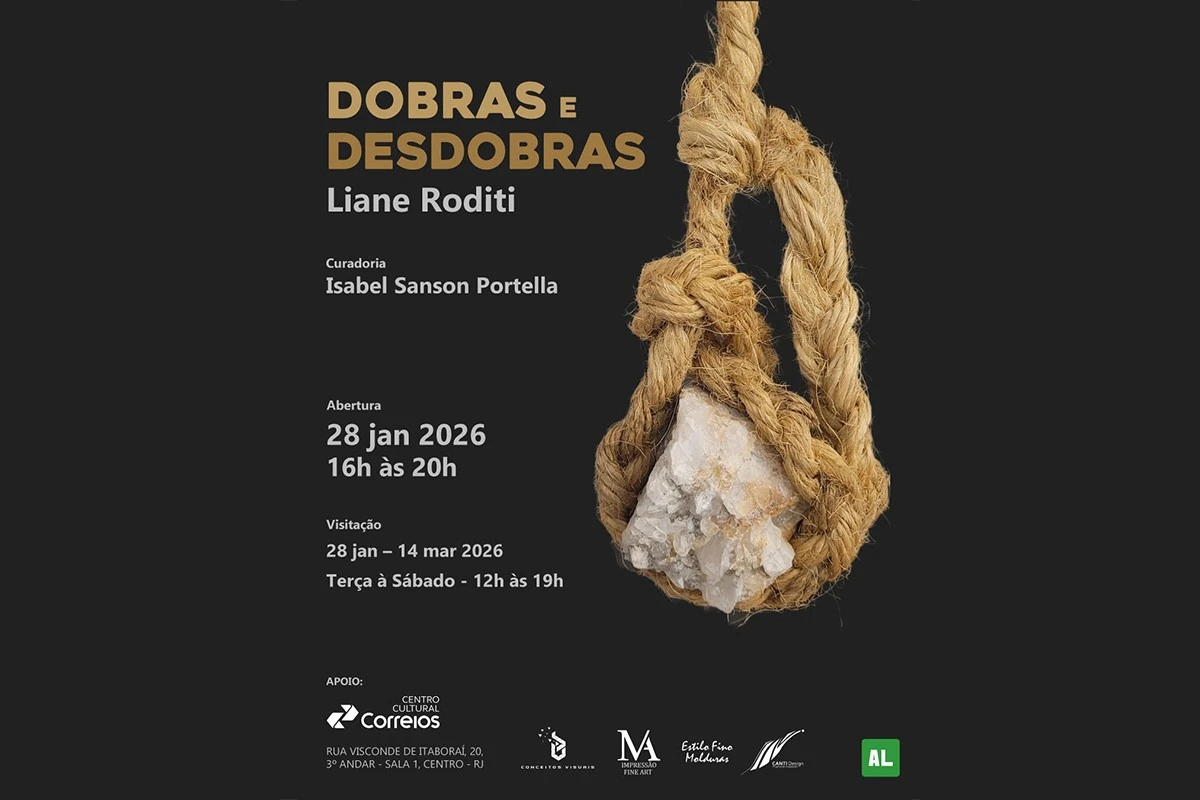
“Dobras e Desdobras” is Liane Roditi’s first solo exhibition at Centro Cultural Correios Rio de Janeiro, curated by Isabel Sanson Portella. It opens on January 28, 2026, from 4pm to 8pm, with the performance “Até 120” at 6:30pm. Admission is free.
Bringing together around 40 works, the exhibition examines the relationships between body, memory, and matter. Roditi places structures of silencing, erasure, and the objectification of women at the center of the visitor’s path. The result is an immersive environment where gesture, material choices, and light shape the narrative.
Body, memory, matter
With a background in dance, Roditi begins from the moving body and its constant transformations under patriarchal conditions. In her practice, the body becomes a territory of experience, perception, and memory — and also a tool for expression and resistance.
Her work moves across performance, video, photography, drawing, painting, sculpture, and installation. Stones, hair, plant fibers, sisal, fabrics, and everyday fragments recur as materials, linking personal experience to collective history through layered forms.
“The strength of Liane Roditi’s work lies in unfolding, movement, transformation.”
Curator Isabel Sanson Portella describes a tension between wear and endurance, continuity and finitude. Here, the body functions as the structural axis, appearing as an extension of nature and history, marked by traces that remain embedded in memory.
“Até 120” opens the show
The performance “Até 120” (2025) opens the exhibition and concentrates key questions from Roditi’s research. She treats the body as a site of accumulation, where time settles slowly and visible and invisible weights build over a lifetime. The action unfolds through repetition and choice, moving between holding on and letting go.
The gesture points to the quiet effort of carrying memories, affects, guilt, and responsibilities. “The performance comes from the need to look at what I carry, without naming or classifying it, just recognizing it,” the artist says.
A video seen through a monocle
That sense of accumulation and dissolution also runs through “Sal,” shown through a monocle installed on the wall. Historically tied to intimate viewing, the optical device creates a concentrated, silent encounter that asks visitors to physically lean in.
In the video, the artist walks into the sea at night, lit only by moonlight, until she disappears into the distance. Looking through the monocle, viewers follow the body’s disappearance in darkness at close range, intensifying immersion and activating ideas of erasure and silence.
Braiding as survival and resistance
Hair, sisal, and plant fibers appear in installations that evoke manual labor, ancestry, and networks connecting women. References to stories such as Saint Barbara’s trajectory and the tale of Rapunzel broaden the discussion of confinement, control, and violence imposed on women’s bodies.
In “Ossatura” (2026), a site-specific installation with 180 meters of braided fibers, sisal, hair, stones, and organic elements, Roditi builds a structure that crosses the space like a body holding itself up. Braiding reads as an affectionate gesture, yet it also signals survival and resistance, echoing knowledge attributed to enslaved women who hid seeds and created maps in their hair.
Highlights and a chiaroscuro mood
Among the highlights, “Vertebrada” (2024) presents an 18-meter veil made of tulle and voile, embroidered with 33 river stones. The rows evoke vertebrae, drawing a symbolic parallel to the weight historically borne by women. The photographic polyptych “Ocultar Revelando” (2023) also stands out, reinforcing Roditi’s interest in lines, forms, and the tension between light and shadow.
In “Campo de Forças” (2025), sculptures of body fragments cast in stone plaster and fixed directly to the wall produce a suspended tension. It remains unclear whether these bodies are being absorbed by the surface or trying to break through it. The ambiguity connects to “The Yellow Wallpaper” by Charlotte Perkins Gilman, a key reference for Roditi on marriage, control, and the erasure of women’s bodies.
The exhibition design uses low-contrast lighting focused on the works, creating an intimate, oneiric atmosphere. Fibers, sisal, and stones trace lines through the room, linking floor and walls. Stones act as anchors of weight and memory, suggesting paths and trajectories that are often made invisible.
“Dobras e Desdobras” runs through March 14, 2026. Visiting hours are Tuesday to Saturday, 12pm to 7pm. Free admission.
Visitor information
Exhibition: Dobras e Desdobras
Artist: Liane Roditi
Curated by: Isabel Sanson Portella
Opening: January 28, 2026, 4pm to 8pm
Performance: Até 120, 6:30pm
On view: through March 14, 2026
Venue: Centro Cultural Correios Rio de Janeiro
Address: Rua Visconde de Itaboraí, 20 – Centro, Rio de Janeiro
Hours: Tuesday to Saturday, 12pm to 7pm
Free admission
Foto: Divulgação
Gostou do nosso conteúdo?
Seu apoio faz toda a diferença para continuarmos produzindo material de qualidade! Se você apreciou o post, deixe seu comentário, compartilhe com seus amigos. Sua ajuda é fundamental para que possamos seguir em frente! 😊
