
British economist explored Ilê Aiyê’s initiatives in Salvador and proposed international exchanges to study the afro bloc’s creative economy model.
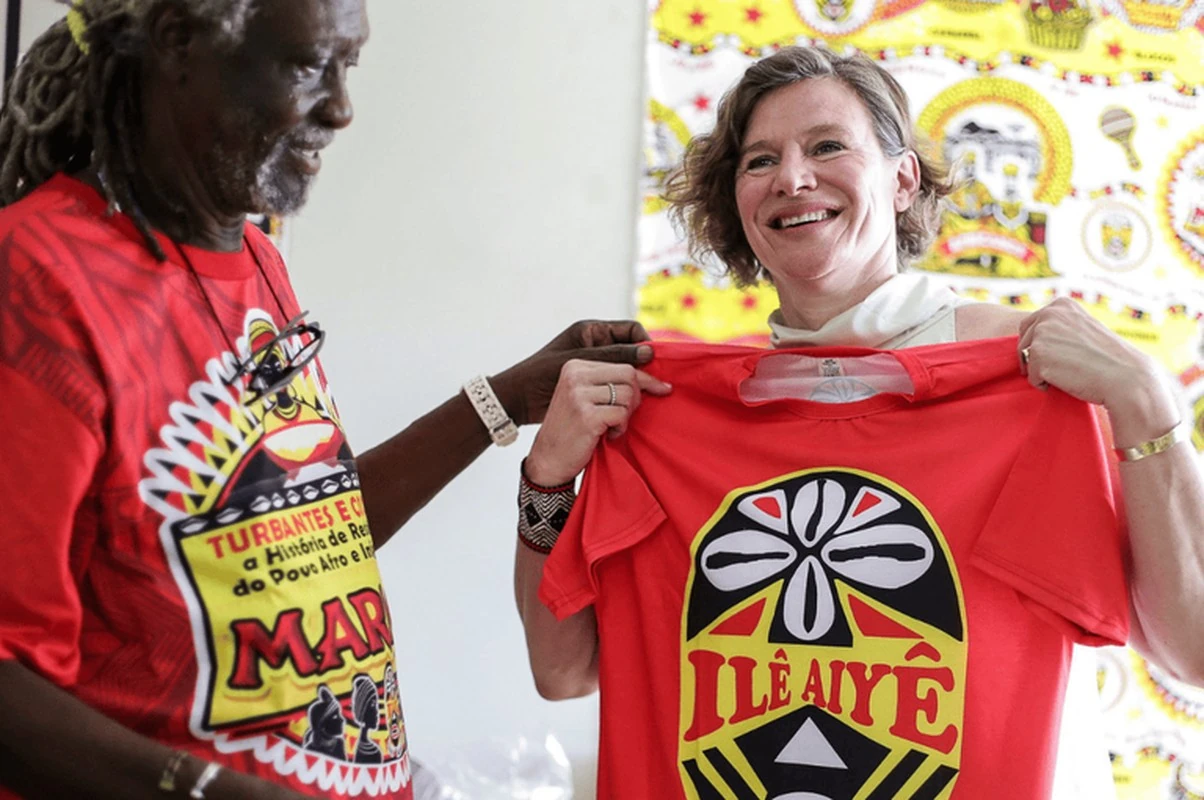
Economist Mariana Mazzucato, director of the Institute for Innovation and Public Purpose (IIPP) at University College London (UCL), visited the Senzala do Barro Preto — headquarters of the afro bloc Ilê Aiyê — in Salvador on Thursday (12). The agenda is part of an international research mission on culture, creative economy, and Carnival, conducted in partnership with Brazil’s Ministry of Culture and technical cooperation from UNESCO.
One of Brazil’s leading afro blocs, Ilê Aiyê develops extensive social work in the Curuzu community. The structure maintains a free elementary school (grades 1-4), sewing classes, and other initiatives that generate around 250 permanent jobs. During Carnival, an additional 100 temporary positions are created.
At the headquarters, more than three thousand costumes worn in the Carnival parade are designed, produced, and sold. All logistical work — instrument assembly and food preparation — is done on-site by community members.
Ilê is a reference in the community and our priority is not the Carnival costume, but the social integration programs Edmilson das Neves, bloc director
Edmilson emphasized that Ilê’s sociocultural work functions as a beacon against racism. He also highlighted the female strength within the organization: “80% of this bloc’s members are women. This is a matriarchal house.”
A model to replicate
Mariana Mazzucato drew attention to the project’s scope and its capacity for realization. “Ilê is a castle that needs to be replicated as a system. It’s an excellent example to follow,” she stated. The economist suggested exchanges and conferences with bloc members to deepen studies on the Creative Economy.
Vovô do Ilê, the bloc’s founder, emphasized that Senzala do Barro Preto represents the opposite of historical slave quarters. “What we have here is welcoming, self-esteem, and transformation,” he said.
Also on Thursday, Mazzucato attended the official Carnival opening and met with Ana Paula Matos, Salvador’s vice-mayor and municipal secretary of Culture and Tourism, to discuss possible cooperation initiatives.
I want to be alongside you and having the Ministry here is very important. I hope this research can help us see our potential Ana Paula Matos, Salvador’s vice-mayor
According to the official, Salvador’s Carnival generates 250,000 jobs. The City Hall offers childcare services with health support for children of Carnival workers who have no one to leave their kids with during the festivities.
The international mission has already visited Rio de Janeiro and Brasília. The initiative is part of the Brazilian Government’s effort to reposition culture as a strategic axis for national development, state planning, and strengthening public capacities.
Photo: Amanda Tropicana
Gostou do nosso conteúdo?
Seu apoio faz toda a diferença para continuarmos produzindo material de qualidade! Se você apreciou o post, deixe seu comentário, compartilhe com seus amigos. Sua ajuda é fundamental para que possamos seguir em frente! 😊
