
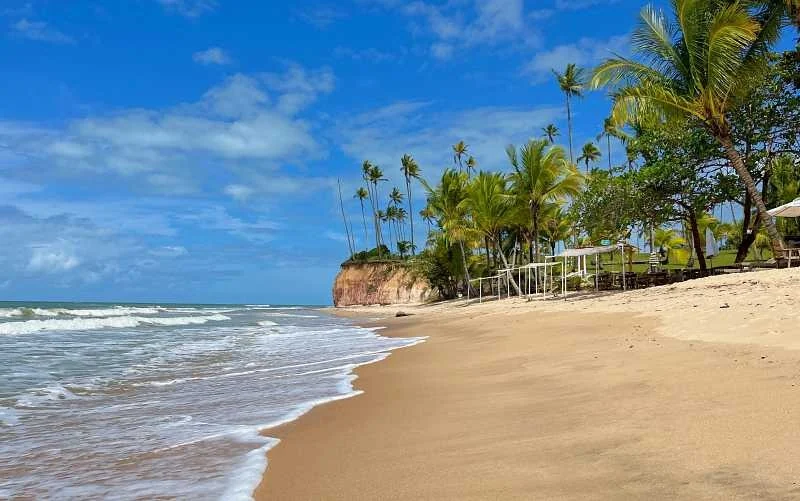
On the evening of April 22, 1500, Cabral’s crew stepped ashore at Barra do Cahy — and the view from the sea remains unchanged to this day.
Where Brazilian history began
Barra do Cahy is no ordinary beach. On the afternoon of April 22, 1500, Portuguese sailors from Pedro Álvares Cabral’s fleet set foot on Brazilian soil here for the very first time. More than five centuries later, those arriving by boat still see Monte Pascoal rising behind the cliffs — the exact same view that astonished European navigators on that historic day.
The mountain stands just 28 km away in a straight line, in the municipality of Porto Seguro. From the sea, it appears behind the cliffs in a subtle optical illusion — as if nature itself marked the meeting of two worlds.
Caminha’s words on the “New World”
The wonder felt by the Portuguese upon arriving in this unknown land was captured in the Letter of Pero Vaz de Caminha, the founding document of Brazilian history. Caminha wrote in vivid detail about the land’s inhabitants, their body paintings and the natural ease with which they lived.
“There you would see figures painted in black and red, quartered on their bodies and legs, which certainly looked fine. Among them also walked four or five young women, who being naked did not appear unseemly. One of them had her thigh, from knee to hip and buttock, entirely stained with that black dye, and the rest of her natural color. Another had both knees and the hollows of her feet stained, and also the tops of her feet; and her private parts so naked and exposed with such innocence that there was no shame in it whatsoever.”
— Pero Vaz de Caminha, Letter to King Manuel I, 1500
A beach within a living reserve
Today, Barra do Cahy lies within the RESEX Corumbau extractive reserve, surrounded by the communities of Veleiro, Imbassuaba, and Cumuruxatiba, as well as the Indigenous Territories of Comexatiba and Barra Velha. Artisanal fishing remains the region’s primary livelihood. A new frontier is also emerging: ethnotourism and community-based tourism, a sustainable model that places local communities at the heart of the visitor experience.
The beach is located 47 km north of Prado and 15 km north of Cumuruxatiba, two of the most beloved destinations along the Costa das Baleias (Whale Coast) in southern Bahia.
Prado and the Whale Coast
Prado is the region’s main reference point. With 84 km of beaches, sandy cliffs, coconut palms, and crystal-clear waters shifting between blue and green, the town welcomes visitors year-round at an unhurried pace. Must-see spots include the Guaratiba beach resort, Cumuruxatiba, Corumbau, and the central beaches of Paixão and Tororão.
Between June and October, the region hosts one of the world’s most breathtaking natural spectacles: the humpback whale migration. The whales travel from polar waters to the warm Brazilian coast to breed, and Prado is recognized as one of the best whale-watching points on the planet. Boat tours depart from Prado, Cumuruxatiba, and Corumbau. The Guaratiba Reef also stands out as a snorkeling destination, with colorful fish and coral formations waiting beneath the surface.
Event Info
- Location: Barra do Cahy, RESEX Corumbau, southern Bahia coast, Brazil
- Distances: 47 km north of Prado; 15 km north of Cumuruxatiba; 28 km from Monte Pascoal (Porto Seguro)
- Region: Costa das Baleias (Whale Coast), Bahia
- Humpback whale season: June through October
- Activities: artisanal fishing, ethnotourism, community-based tourism, whale watching, snorkeling at Guaratiba Reef
Gostou do nosso conteúdo?
Seu apoio faz toda a diferença para continuarmos produzindo material de qualidade! Se você apreciou o post, deixe seu comentário, compartilhe com seus amigos. Sua ajuda é fundamental para que possamos seguir em frente! 😊
